
It’s safe to say that being a marketing professional is a bit…tense these days. The pace of change in ai-driven technologies like agentic workflows is making most of us feel like we’re constantly play catch up. And there’s no breather on the horizon. Predictions of exponential developments crowd our inbox and our reading lists. It seems to be that the only way past this pain is through it. We as marketers need to adopt and adapt.
According to recent McKinsey survey results, ” Almost all survey respondents say their organizations are using AI, and many have begun to use AI agents (this includes agentic workflows). But most are still in the early stages of scaling AI and capturing enterprise-level value.” So where do agentic workflows fit into all this?
The answer is they go from being simple copy-paste users of AI chats and even complex no-code automation systems to more agile systems that are built to take advantage of AI’s speed while building in guardrails to avoid some of AI’s eccentricities. Understanding and piloting agentic workflows now is how forward-looking agencies protect margins and create new value.
What Exactly Is an Agentic Workflow?
In short, it’s a structured process where AI “agents” can perceive context, make some carefully curated decisions, and take actions toward defined business goals.
An example would be a system that goes out to any of a number of sources, get leads, vet them, enrich them and cold email them with a link to book a call. Because of their flexibility, they can pivot more easily than no-code workflows built on n8n, Make.com or Zapier. So instead of lengthy debugging of a Zapier workflow when something stops working, you can pivot more easily because the system is designed to troubleshoot itself. This can be a huge time saver especially for tight turnaround environments like marketing agencies.
Why Should Agencies Care About Agentic Workflows?
There are several levers that agentic workflows can pull for agencies.
- Speed in Development and Execution
Building tools like lead scrapers, research tools and auto posters can be accomplished with no-code tools like n8n and Make but can take some time to debug and get clunky as complexity is added. You have single points of failure that kill everything downstream. With agentic workflows, the guard-railed AI can make edits much more quicly. It can do tests on smaller datasets just by asking it to instead of setting variables. The time savings can be significant. - You Expand Your Automation Possibilities
How do you know if something is even possible and what kind of time it can take to spin up? Agentic workflows can make suggestions for solutions to problems that you might not think of off the top of your head. Need to see a couple of options? Great. Just ask. Boom. There’s three possibilities you can choose from. - Much Tighter Control Than Mere Chat Prompts
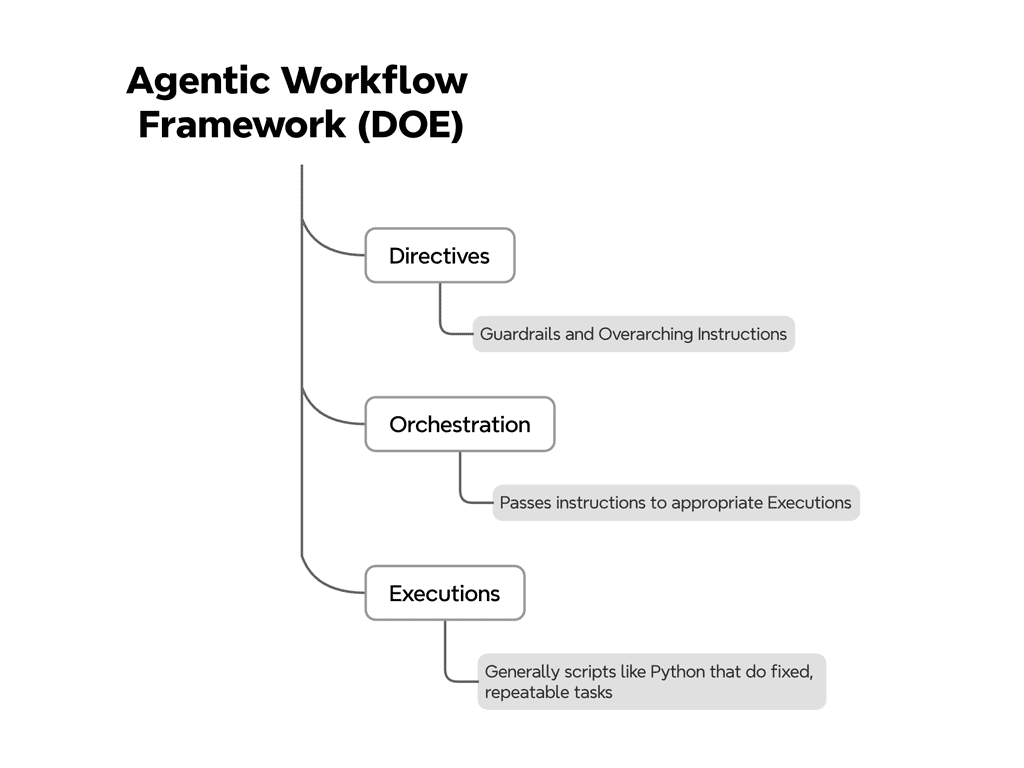
You can set limits as to what you allow your assistant to do. Using a framework like DOE or LangChain can greatly increase the accuracy of AI-driven systems. They keep your interactions on point because you control the rules the AI assistant has to go by.
So while you may see results from chat interactions and no-code platforms, agentic workflows have the potential to lean into AI’s advantages while limiting the downside.
So What Are the Use Cases for Agentic Workflows?
The greatest advantage that agentic workflows can bring to the table currently is the ability to monitor and react with an appropriate action or perform complex automations. Some examples include:
- Complex Data Acquisition, Enrichment and Leveraging
A common use case is data acquisition (aka, scraping) for marketing efforts. It’s easier than ever now to chain complex tasks and schedule them to be run at intervals or on demand. Wait, you say that sounds like automations on no-code platforms? Yes but it’s faster and more flexible. Even though setup is still not instant, it can be way faster to setup than with other platforms. - Monitoring Trends and Reporting
By connecting to APIs you can build more robust reporting than some commercial platforms offer, increasing your value add. Image a programatic advertising plaform whose reporting isn’t exactly what you want. Agentic workflows offer a wider variety of options than some platforms might offer. Now getting access to those fields? Well that’s another issue… - Content Engines
Agentic workflows are possible that take repurposing content to another level. Yes, Stephen Pope’s No-Code Architects system is a marvel. But going through it is not for the faint of heart. I am watching him closely and may get involved but for now, if I can figure out a system in my head, I’ll probably be able to get a good deal of the value more complex systems offer in significantly less time by using agentic workflows.
Content engines take a single piece of content and tailor it to multiple platforms based on definitions. So one blog post rolls into a podcast, a YouTube video, social media posts and more. I can imagine this would be hugely powerful attached to a programmatic advertising platform.
Next Steps
- Agentic workflows aren’t about replacing human creativity — they operationalize it.
- Talent roles evolve from doing to directing: humans provide judgment, insight, and taste.
The agencies that codify how they deliver value—and let AI run the repeatable parts—win client trust and protect profitability. Agentic workflows can leverage what AI does best while limiting exposure to the dark side.
Schedule a Call With Tenon SEM Today
If you’re interested in leverage the power of agentic workflows, reach out today and let’s get a quick 15 minute call.